
Views: 186 Author: Site Editor Publish Time: 2022-10-07 Origin: Site
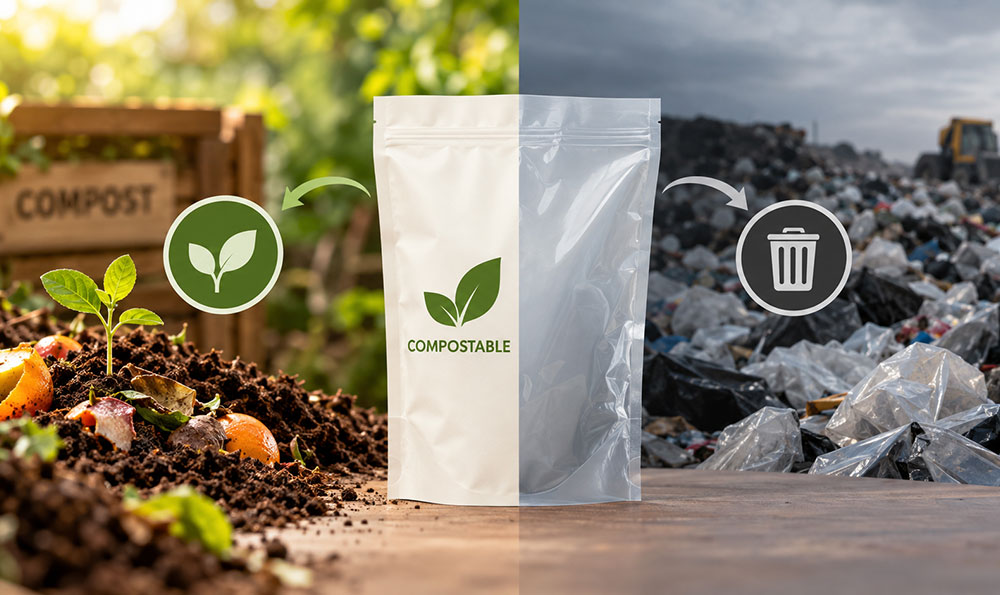
Are Compostable Bags Better for the Environment?
The short answer is: they can be — but not in every application.
Compostable bags are often promoted as a more sustainable alternative to conventional flexible packaging. However, whether a compostable package actually delivers a better environmental outcome depends on much more than the material itself.
The packaged product, required shelf life, material structure, composting certification, local collection system and what happens to the package after use all matter.
A compostable bag is packaging designed to biodegrade under defined composting conditions and meet specific requirements relating to biodegradation, disintegration and compost quality.
This is different from simply calling packaging "biodegradable."
All compostable plastics are biodegradable under the appropriate composting conditions, but not every biodegradable plastic qualifies as compostable.
Commercial compostability standards establish specific conditions and performance requirements so that qualifying materials can break down alongside other compostable materials without negatively affecting the resulting compost.
Depending on the application, compostable flexible packaging may use combinations of compostable films, cellulose-based materials, sealant layers, coatings, printing inks and functional components.
That means buyers should evaluate the complete packaging structure, rather than assuming that one compostable film automatically makes the finished pouch compostable.
Not automatically.
There are situations where compostable packaging can provide a meaningful end-of-life benefit, particularly when the package is likely to be collected together with organic waste.
There are also applications where recyclable packaging, reusable packaging or packaging reduction may offer a more practical solution.
Three questions help determine whether compostable packaging is appropriate:
1. Will the packaging actually enter a composting system?
A certified commercially compostable pouch is designed for specific composting conditions.
If it is placed in general waste and sent to landfill, those intended composting conditions are unlikely to exist.
Compostability therefore does not mean that packaging will simply disappear wherever it is discarded.
The local collection and processing infrastructure matters.
2. Is the package connected with organic waste?
Compostable packaging can be particularly useful where separating the packaging from food or other organic material is difficult.
Examples may include certain:
Tea and coffee filter formats
Single-serve beverage systems
Foodservice applications
Produce labels
Bags associated with collected organic waste
In these cases, packaging and organic contents can potentially move through the same managed bio-waste stream where appropriate infrastructure exists.
3. Does the packaging still protect the product effectively?
This is especially important for food packaging.
A sustainable package that causes food to lose freshness prematurely may create additional product waste.
Coffee, nuts, granola, dried fruit, powders, tea and snacks can all have different requirements for:
Oxygen barrier
Moisture barrier
Aroma protection
Grease resistance
Seal integrity
Mechanical strength
Material selection should therefore start with the product's protection requirements and expected shelf life.

One of the most common misconceptions about compostable bags is that they will quickly disappear in soil, the ocean or landfill.
That is not what commercial compostability certification means.
Industrial composting facilities create managed biological conditions involving moisture, microorganisms, oxygen and controlled temperatures.
Packaging designed for these facilities should therefore be described as commercially or industrially compostable, where applicable.
Home composting is different.
A backyard compost pile generally operates at lower and more variable temperatures than an industrial composting facility.
For this reason, commercially compostable and home-compostable packaging should not be treated as interchangeable terms.
Brands should clearly identify which end-of-life route applies to their packaging.
Understanding this distinction is essential when sourcing compostable packaging.
Commercially Compostable Packaging
In North America, ASTM D6400 is one of the principal standards covering plastics and plastic-containing products designed for aerobic municipal or industrial composting facilities.
Home-Compostable Packaging
Home compostability requires packaging to perform under different conditions.
A pouch suitable for industrial composting therefore should not automatically be marketed as suitable for a backyard compost bin.
Procurement teams should verify exactly what certification applies to the proposed packaging structure.
This question should not be answered with a universal "yes."
A package's carbon footprint can be influenced by:
Raw material sourcing
Manufacturing
Film conversion
Printing
Transportation
Package weight
Product protection
Food waste
Collection
Processing
Final disposal
For this reason, compostability and carbon footprint are two different environmental characteristics.
A product can be compostable without automatically having a lower overall carbon footprint than every alternative.
Brands making quantitative carbon-reduction claims should therefore rely on appropriate product-specific data or life-cycle assessment rather than assuming compostability alone proves a reduction.
For the right application, compostable packaging can support both a product's end-of-life strategy and a brand's sustainability positioning.
But compostability should not be treated as a universal replacement for every type of flexible packaging.
The most credible packaging strategy considers:
Product protection
Packaging weight
Material structure
Compostability or recyclability
Certification
Target-market regulations
Local waste infrastructure
Consumer disposal behavior
The goal is not to choose the material with the greenest-sounding name.
The goal is to design a packaging system that performs properly during use and has a realistic end-of-life pathway after use.
Are compostable bags actually compostable?
Certified compostable bags are designed to meet defined compostability requirements under specified conditions. Commercially compostable products generally require an appropriate industrial or municipal composting environment unless they are separately certified for home composting.
Are compostable bags biodegradable?
Yes, compostability involves biodegradation, but "biodegradable" is a broader term. A biodegradable claim alone does not tell a buyer where, how quickly or under what conditions a material will break down.
Can compostable bags go into home compost?
Only when the product is designed and appropriately certified for home composting. Commercially compostable packaging should not automatically be placed in a home compost bin.
Can compostable packaging go into landfill?
Compostable packaging is designed for composting systems, not landfill disposal. Sending it to landfill does not provide the controlled conditions for which the packaging was designed.
Are compostable bags better than recyclable bags?
Neither is universally better. Compostable packaging can be useful for certain applications connected with organic waste, while recyclable mono-material packaging may offer a more practical end-of-life solution in markets with suitable recycling infrastructure.
Are compostable bags suitable for food packaging?
They can be, provided the packaging structure satisfies applicable food-contact requirements and provides sufficient barrier, sealing and mechanical performance for the packaged product.
What information should I provide when requesting a compostable pouch quotation?
Provide the product type, filling weight, bag dimensions or target capacity, required shelf life, target market, preferred pouch style, printing requirements, zipper or valve requirements and expected order quantity.


